Tuesday, 27 January 2015

The rules Cannae take it ... well actually they can.

I recently bought a set of rules called "To The Strongest!" by Simon Miller (BigRedBatCave). Myself and my good friend Stuart tried them out.

I set up a Cannae style battle of Romans and Carthaginians. The thinking being that if a set of rules can "do Cannae" they must be OK.

 Overview, Romans on the right

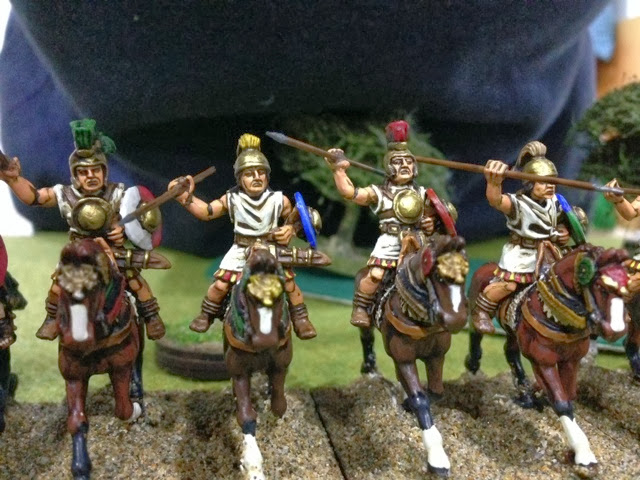
 Latin Cavalry
 Roman Cavalry
 The Legions
 Punic and Spanish Cavalry with Punic heavy foot behind
 Numidian cavalry with more Punic foot
Gauls and Spanish in the centre

No points were used, I just laid out two armies that looked about right.

To the Strongest! uses a grid for movement and weapon ranges. I marked mine out with little green sticky disks bought in W H Smith. My grid was built with six inch squares (rules suggest 150mm but 6" is close and quicker to measure out with my ruler). Units have to fit into the boxes, I went with a unit frontage of 120mm for foot and 100mm for horse. My foot figures are on 40mm Squares so three to a unit. Cavalry on 25X50 so four to a unit. The Roman heavy infantry are in small units so I gave them an 80mm frontage. These frontages are not too important, it is the grid that matters.

Each unit with a distance weapon has an ammunition supply. I represented this with some coins covered in sand and flock (some with arrows) that I use as casualty markers with other rules. As units shoot they give up ammunition. Once exhausted they cannot shoot. There is a limited resupply available. Units that pass a test can take on more ammo.

Each army is divided into commands. Activation is per "box" for a command. The command activates units in boxes until it fails or runs out of things to do. Units can do multiple things in a "turn", we had units doing up to four actions. To activate the unit must pass a test. This test is a number that must be exceeded. All tests are performed using the number cards from two standard decks of playing cards. You declare what a unit will do, turn over a card and if you pass the unit takes its action. You can then move onto another unit or re-activate the unit just activated. It becomes increasingly difficult to get units to activate after the first attempt.

Shooting and combat also use the cards. Target numbers to hit (e.g. 8 for shooting) and then a save. Variability in troop types is mostly built into the save values. There is a lot more to the rules than I have described here of course. I was wary about playing card clutter on the table so I found some tiny cards (about 40X20), these worked well.

So to our game. I took on the Romans, Stuart had the Carthos.

The armies got to grips very quickly. Shooting was ineffectual and most units expended their ammunition to no avail. Hand to hand combat was brutal and fast. The Roman small units are very flexible and pretty hard hitting (they demolished two gallic war bands) but they can only take one hit so they died quite rapidly.

There were protracted cavalry actions on the flanks. Where the medium cavalry clashed the hand to hand fighting went on for a while with lots of rallying and re-joining the fight. Where the Latin cavalry were fighting Numidians there were evades and chases which covered a lot of that quarter length of the table.

Eventually the Roman cavalry was eliminated and the Latins neutralised. At this point the Carthaginian heavy foot advanced and turned to face each Roman flank. The Romans kept up the pressure in the centre. Both armies were one victory point away from defeat (as units are lost victory tokens are surrendered from an allocation made at the start). The Romans almost burst through the Carthaginian centre but failed their activations (two aces in a row). Then the Punic pincer gripped and the Romans lost a unit. It was all over. The Carthaginian cavalry was poised to trap the Romans ...

End of the game

So yes the rules can do Cannae (or something a little bit like it).

Overall. We liked the grid, made movement simple and removed any arguments about the eligibility of moves. I was sceptical about the cards but they are easy to use and very fast. We had fifty units on the table and played to a conclusion in 2 1/2 hours. The mechanism for Roman line relief is very subtle and worked well. Effectively if the Hastati die the Principes  get to strike back for them.

We will be playing these again. They are faster and less fiddly than Sword and Spear (which we like) so better for big games.



Saturday, 4 January 2014

Experiment with Dux Bellorum for Ancients


I picked up wargames Soldiers & Strategy issue 70 the other day. On page 34 there is an article on using Dan Merseys Dux Bellorum dark ages rules for ancient games by Allen E Curtis. I have had a number of excellent games using these rules for their intended period so I thought I would give them a try with Ancients.

I set up a 6x5 table with figures representing Syracusans and Spanish from the mid 3rd century BCE.

Here is a view of the Syracusans 

This a view of the Spanish line.

I started by taking the standard troop types from the book.

I treated Hoplites as ordinary Shieldwall 
I  classified one unit of Hoplites as Companions (representing the tyrant and his elite mercenary guards).
I decided to try out some Gauls? I used the special rule for fanatics to cover these.
Greek style cavalry were treated as ordinary riders. Greek style light cavalry were treated as mounted Skirmishers with javelins.
I made up a standard 32 point army using 6 units of Hoplites, two of Gauls and one each of heavy and light cavalry.

I decided to avoid skirmishing infantry for this first attempt.

For the Spanish I took one unit of mounted Companions to represent the King and his body guard.
I took a unit of mounted nobles to represent Spanish medium cavalry (this made them a little better than the Syracusan cavalry).

The Scutarii were treated as warriors. I decided to waive the rule that makes them impetuous and gave them the hurled weapons special rule to represent their heavy throwing spears. This is a departure from the rules as written where hurled weapons is reserved for Shieldwall troops.

For the Caetrati I treated them as warriors with the javelins special rule.

I made up my Spanish army from one unit of mounted companions, one of noble cavalry, one of mounted Skirmishers, two of Caetrati and three of Scutarii.

I gave each unit a frontage of  about 160 mm and used 6 inches to represent a base width for measuring.

In my game the Spanish noble cavalry and the Syracusans medium horse quickly came to grips. this fight went on for a while. I think that this melee went on for too long, 3 or 4 rounds of drawn combat.

The Gallic fanatics rushed across the field and hit the Spanish mounted companions and a unit of Caetrati. The Gauls were destroyed in a single move. This was dramatic. The fanatics look interesting but they are very fragile. 

On the other flank the opposing mounted Skirmishers came within range and traded ineffective javelin throws for a number of moves. After a while I got bored and charged one unit into the other. they destroyed each other in one round of fighting.

In the centre the Hoplites moved forward and eventually charged the Spanish line. The battle went to and fro for 3 moves. By this point (move 7) the Syracusans army was looking weak. The cavalry had gone, the Gallic nutters were history, losing one unit of Hoplites would trigger morale tests. 

This happened next move and the Syracusans collapsed (ordinary troops have morale 7, you have to throw the morale value or lower to survive).

Spanish victory.

My thoughts.

First off; it worked. An enjoyable game fought solo in about an hour.

I forgot about interrupting enemy moves in order to get the jump on charges. This would have made a difference to the game.

What would I change.
Look at the Gauls! Make them noble warriors rather than fanatics.

Add a rule to break off drawn cavalry combats. maybe after two turns of drawing.

Look at using the rider stats for skirmishing cavalry but still have them move as Skirmishers. They would last a bit longer.


Here are a few shots of the figures.

Friday, 3 May 2013

A Viking Army in Under Two Weeks!

At Salute this year I bought some of Gripping Beast's new plastic Unarmoured Dark Age Warriors. As I already had some armoured plastic Vikings from them, sitting in the plastic pile, I thought I would make myself a Viking Army. I added some archers from Crusader and got to work.

The new plastic figures are really easy to put together and I had a box full (40) ready to undercoat pretty quickly. I undercoat in brown enamels so this was done and they were left to dry.

I then set to painting in batches of 10-12. First a batch of unarmoured, then some armoured and so on; sneaking in the archers as I went.

I managed to get 1-2 hours of modelling/painting in each day. Now, 13 days after Salute I have a little army. Big enough for Dux Bellorum or Basic Impetus. Total 85 figures.

I sneaked in 3 metal GB figures that I had already painted and 12 of the plastic Vikings had been painted to double up as Gallowglas in my WotR army. So 70 figures in 13 days.

Here are some pictures (done on iPhone). Note that I used a couple of heads from the armoured box on the new figures (fit perfectly).


Wednesday, 27 June 2012

Frosted toys

Yesterday I sprayed three 28mm ECW figures with GW Purity Seal Satin Varnish. They looked great.

Now I usually avoid sprays because I have had disasters with frosted figures. I used the spray because I was in a hurry.

Today I sprayed another 13 figures. They frosted! Same can of spray, same shaking, sprayed in same place (outside).

Today is more humid - so that must be the issue.

I managed to fix the figures. Here's how.

First I brushed on some Daler-Rowney Soluble gloss varnish.

When the figures were dry I brushed on Windsor and Newton Galleria Matt Varnish

Worked brilliantly with no frosting.

The picture shows the result.


Now I need to base them up.

- Posted using BlogPress from my iPad

Friday, 22 June 2012

Roman and Punics on Parade

I had the table out for a game last night. This morning I thought that I would get a visual representation of how my Punic wars armies are coming on. So here are some pictures.


Romans


Carthaginians

A few close-ups


Wednesday, 20 June 2012

Republican Romans

Just a few pictures of my Renegade Republican Romans.


Velites - two small units for Hail Caesar


Two more units of Velites


Two of Hastati


More Hastati


Two Principes


The other two Principes


One of the two units of Triarii


Small unit of Equites


More Equites


The whole lot. Javelinmen in front are from Crusader.


Overview shot.

Hope you like them.

Greek Light Cavalry

Some Greek Light Cavalry; from the Victrix set of the same name. I did add in a few heads from the spares box.