I am currently painting up three boxes of Conquest Games Plastic Norman Knights.
They are brilliant. The Horses look better than any 28mm horses I have painted before. Well proportioned, nice poses.
The riders fit perfectly and have a good range of options.
The horses need something to eliminate the seam between the head and body. My usual glue for plastics is Revell Contacta with a paint brush. This is accurate and fast, but it doesn't fill gaps. After a few attempts with fillers I went back to the way I used to construct airfix kits 35 years ago. I bought some old-fashioned polystyrene cement in a tube. I used this to cover the surface on the body where the head is attached and then squashed the head on, letting the glue ooze out of the gap. I then left this to try for 24 hours. I then chipped off the excess glue with a modelling blade. The gap no longer existed.
I have painted the figures using a mix of techniques. All were sprayed with black primer.
The "brown" horses have been base coated with Cote-d'arms Horse Tones, then washed with Citadel washes (Devlan Mun or Gryphon Sepia), then highlighted with the base colour.
White horses have been painted with a triad of Valejo Sky Grey, Silver Grey and Off-White.
Black Horses with Valejo Black-Gray highlight over the black primer.
The knights were dry-brushed with Valejo natural steel, then washed with GW Badab-Black. Then I gave them a lighter drybrush with the natural steel.
Flesh (not much to actually paint here) was base-coated with Valejo cavalry-brown, then painted with Valejo flesh-base. I then gave it a wash of GW Ogryn-flesh and highlighted with the flesh-base.
For the small areas of cloth I used a two-colour (diad?) technique of a base coat and highlight. The exception to this was red. I do my reds by base coating with VJ Cavalry-brown, then VJ Red and finally VJ Scarlet.
Leather was done with VJ Flat-Brown, GW Devlan Mud wash and then high-light with the Flat-Brown.
I varied the leather by doing some areas in VJ German Camouflage Orange Ochre (my favourite Valejo light brown) or VJ Buff with GW washes and a highlight in the base colour.
For the sheilds I went for hand-painting. This is for a couple of reasons. Firstly, there are no transfers in the Conquest boxes. Secondly, I couldn't be bothered to try and find transfres that would fit, Third, I love the look of the painted crusaders on the Perry web-site, with hand painted sheilds. Finally, I like the idea of the shields looking like the ones on the Bayeux Tapestry (styalised and simple). I assume that real shield designs were more sophisticated than those rendered on the tapestry, but as my painting skills are on a par with the art on the tapestry (on a good day) this level would suite.
So I used triads to paint the shields. My triad painting is usually rather subtle and doesn't stand out much. For these shields I went rather more extreme than my usual style (greater variation between shades and larger areas of shade). It seems to have worked.
Basing was a challenge. I have not decided on rules for these yet (or even if they will become an army). The box includes a set of Renadra cavalry bases. These or 25mmx50mm and 50mmx50mm. I based all of the figures individually on 25x50's. I have found that these bases will glue together using Contacta so I can make them into 50x50 or 75x50 later.
The basing will work for Warhammer Ancient Battles and the Crusader rules. I think it will be OK for the planned Warlord Games Ancient Rules. With a movement tray I can get four figures onto an Impetus base (120x80). I don't expect to use these figures for DBA/M/MM.
Conclusion: Great figures, will mix with Perry Crusades. Good value. I am really enjoying painting them.
Pictures: Just realised my camera isn't available. I will try and do some soon.
Wednesday, 17 November 2010

Thursday, 9 September 2010
Rank and File C2 Playtest
We tried out some command and control rules with Rank and File last Monday evening.
The scenario had 9 regiments of Rebs attacking 6 of federals in a hasty defensive position.
The nature of the game meant that units did not need to make many order changes. When they did the system worked as we expected it to. The range of order types got a good response from the players.
In our game a very strong rebel left slammed into the federal line in successive wave attacks. These drove the defenders back and this flank belonged to johnny reb. In the centre the attacking waves were held by the union troops. On the rebel right it was a different story. Some great shooting from the federal artillery had removed two rebel batteries and a charge by two union regiments drove off a unit of confederate cavalry and was about to slam into the flank of the rebel right centre regiments when we had to call time.
The game was finely balanced when we had to stop. It looked likely that the Rebs would have been able to exit 3 units from the union table edge if they had time for two moreover. This would have fulfilled the victory conditions of the scenario. But by that time Billy yank might have rolled up their centre!
Next week I will put together a more challenging scenario with plenty of opportunity to make order changes.
I am posting this from my iPod as an experiment. When I get back to my pc I will post the latest version of the C2 rules and the scenario that we played this week.
Sunday, 22 August 2010
Rank and File Command and Control Ideas
I have written up some ideas for Command and Control in Rank and File. Primarily for ACW.
Here is a link to a document on Google Docs. Download here.
The ideas are borrwoed from the Forlorn Hope ECW rules, with some adaptations of my own.
I would welcome comments
Here is a link to a document on Google Docs. Download here.
The ideas are borrwoed from the Forlorn Hope ECW rules, with some adaptations of my own.
I would welcome comments
Tuesday, 10 August 2010
ACW Rules Comparison
Our group played the Battle of Kernstown" Scenario (posted on this blog ) with Black Powder and with Rank and File. Here are our findings.
The scenario pits a small, veteran Confederate force against a larger, but inexperienced, Union force. The Confederates have better leaders and more artillery, although some of the artillery is very light.
 Our first game was with Black Powder. Both sides deployed on-table as per the scenario map. Black Powder has an I-go-U-go turn sequence. Each brigade dices to see how much (if any) movement they get. Throughout the game the Union army found it difficult to move. Their best chance for success was to assault the weaker Confederate centre. Unfortunately their green and unreliable troops would not get moving and could not make contact with the Confederates.
Union forces did manage to destroy a tiny Confederate brigade on their extreme right but this proved costly and they were unable to follow up their success. Eventually the Confederates silenced the Union artillery and carried the main objective (a hill in the centre-left of the field).
Black powder has a couple of mechanisms that we found interesting. First is the Blunder. If a leader rolls double-six when ordering troops they have to take a "blunder test". In one case a unit of poorly armed, green Union cavalry were forced to charge towards the Confederate cavalry in march column, they were of course destroyed.
The second interesting mechanic is that units do not visually degrade, there is no removal of figure stands to show attrition. Eventually units are destroyed and removed as a whole.
Conclusions: Black Powder is very fast. We played with two players per side. About 20 units per side and we finished the game in two hours. The system modelled the differences between troops very well. Small Confederate units far outclassed the larger, green Union troops. The small Confederate units however did not have great staying power once they started to suffer.
The only real negative in our game was that the command and control system really punished the Union side and made it very hard for their centre to close in on the Confederates. This is probably realistic but something to look out for in scenario design. In my next scenario I will probably try to keep the abilities of the Brigade and Divisional commanders fairly uniform.
 Our second game was with Rank and File, with it's ACW supplement. We used the same terrain and deployment but adjusted unit sizes slightly.
Rank and File uses a "blended" turn sequence. Both sides declare charges, both attempt rallies, then movement is handled as IGoUGo based on an initiative roll. Firing, Charges and Morale are then handled simultaneously. This system means that all players are engaged at all times. We managed to play moves where the two sides of the table worked at different speeds.
There is no real command and control in this system. There are suggestions in the ACW book but we did not use them. This meant that troops initially do what players want them to do. So in this game the Union centre did press the Confederates and part of the Stonewall brigade had to be sent to help.
However, once troops become engaged they start to get "shaken" morale results from shooting and melee. This causes them to retreat. Repeated shaken results on green troops broke up the Union attack very quickly. The morale rules are very harsh on Green troops who always need to roll six to pass tests. This totally crippled the Union army. Once they started taking casualties they really stopped moving forward. On the Union right they again destroyed the tiny (2 regiments and a gun) Confederate brigade. They were then confronted by the "Stonewall" brigade, behind a stone-wall. The Union player held back and used artillery on this position to little effect. Confederate skirmishers did menace the union batteries in the centre and they were dispersed by a charge of the awful Union cavalry. These were immediately annihilated by every Confederate gun in range.
In conclusion the rules worked and gave an enjoyable game in under three hours. The small Confederate units were effective but lacked staying power. The larger, poor quality, Union units could not pass morale tests after taking casualties.
I took pictures of both games. You can look at these if you click on the sample picture.

So what did we think of the two sets of rules ?
Overall both gave an very enjoyable game within our time-limit for evening club games (about 2-3 hours). Both modelled the period reasonably well considering the level of abstraction they work at.
I think that players preferred the combat mechanisms in Rank and File over those in Black Powder. The Rank and File morale system is very harsh on Green troops, this was seen as a negative. Having units failing to move in Black Powder had a mixed reaction among the group. I liked the fog of war realism that it adds.
I have tried to work out the criteria that are important to our group and come up with something slightly objective as a comparison. (Marks out of 10)
1. The rules must support substantial multi-player games in under three-hours.
BP:9 R&F:8 - BP was faster in our test.
2. Players must be involved as much as possible. No hanging around or missed "goes" (this is why we have rejected card systems like TCHAE).
BP:7 R&F:9 - The R&F turn sequence means no waiting around and supports running different parts of the battle-field at different rates within a turn
3. Engaging Command and Control System
BP:9 R&F:3 - R&F lacks a real CandC system. The optional set in the ACW book looks a little unwieldy, maybe we should try them
4.Combat Mechanisms
BP:7 R&F:8 - Not much to choose here as they are fairly similar. R&F removes stands which I find visually more appealing. But, the BP system does keep all of the pretty toys on the table for as long as possible.
5.Morale system
BP:7 R&F:5 - R&F is harsh, we are looking at some house rules to address this.
6.Visual Appeal - does it look right
BP:10 R&F:10 - Both games looked great, looked how we felt an ACW game should look.
7.Period Feel
BP:8 R&F:8 - R&F has an ACW supplement that covers all of the weapons and correct tactics like wave attacks and use of skirmishers. We applied special rules to BP (the system encourages this) that also gave a good period flavour. They did not score as high as a period specific set might have but very good as they are both generic horse and musket sets.
8.Playability - OK this one is subjective, so I am judging it on how well the games play from the QRS, marking them down for "lookups" in the book.
BP:9 R&F:8 - We have played more R&F than BP. But we looked in the R&F book more during the game. The R&F book is well organised but some things are hidden. Melee results are under the heading "Leader bonus in melee".
Overall BP gets 66 out of 80, R&F gets 59 out of 80.
So which will we play ? I think that the jury is still out. Next test will probably be R&F with some house rules for morale (yet to be worked out) and some sort of command and control. More on that when we get a chance to try it.
Thursday, 5 August 2010
ACW Rules
My wargame buddies and me have been looking for a set of horse and musket rules with which to play regimental level ACW games. Ideally we would like to use the same system for Napoleonics later on.
We have amassed reasonable forces (around 200-240 infantry per side) with cavalry and guns in 28mm. Now we need a great set of rules. The rules need to be fast and inclusive as we play with 3-4 players per side. Any rules that leave a player sitting idle for 20 minutes are unacceptable. We want a commercial set with minimal house rules.
The rules that we have looked at are; Black Powder (BP), Rank and File ACW (R&F), Regimental Fire and Fury (RFF), and They Couldn't Hit an Elephant (TCHAE).
For now we have put TCHAE to one side. There are members of our group who don't really get on with card driven systems and not having a go during a turn. In TCHAE units are activated by cards, the "Coffee" card terminates the current move.
So that leaves us with BP, R&F and the new arrival, RFF.
We have played a few games of Rank and File with it's ACW supplement. This set gives a nice free flowing game and its integrated move sequence means that players are busy most of the time. The ACW supplement is a little difficult to use, so I have created an ACW specific quick reference sheet for the rules. You can download this from the Crusader Publishing forum (ACW QRS V1.pdf).
The R&F system uses a neat turn sequence that has the two sides doing some things sequentially (moving) and most things simultaneously (shooting, melee, morale etc). My main issue with the rules is that the basic rules do not include a command and control mechanism. The role of leaders in the system is to bolster troops. The ACW set does include a system of orders and order changes but I have not found them to be playable in a group game. Now, some members of our group like not having a C&C mechanism because they believe that that is their job. Personally I like some fog of war. That leads nicely into our next choice; Black Powder.
I will lay my cards on the table; I like Black Powder. The mechanisms are simple, the C&C system handles fog of war brilliantly, they are very nicely written. I was hooked after my first (and so far only) game. The issue when playing with this set as a group has been that the turn sequence and the fog of war mechanisms leave some players idle for a little too long. The very simple (but not simplistic) movement rules and very abrupt death of units also left some players less than happy.

Now for the newcomer - Regimental Fire and Fury. I have had my copy for about 36 hours at the time of writing. It is a lovely book and the rules derive their mechanisms from the original Fire and Fury rules. I have had a copy of the original for years but have never actually played them. They are well known by a number of our group and we should pick up the regimental version pretty quickly. The system looks straight forward and of the four sets I have discussed here they are the most thorough looking set. lots of examples, lots of explanations and very little ambiguity. I really want to try this set out. One thing about RFF is that it is very specifically for ACW, BP and R&F cover the whole Horse and Musket era and so will cover our requirement for a standard set for the whole "period".
So, this weekend we are going to try two back to back games, using two sets of rules for the same scenario. I have taken a scenario for 1st Kernstown from the June 2008 edition of Wargames, Soldiers and Strategy magazine as my starting point and added some detail from the scenario for the same battle in the TCHAE book. I have worked out OOB's for each of Black Powder, Rank and File, and Regimental Fire and Fury. You can get a copy of my scenario from Google Documents (Kernstown.pdf)
Hopefully I will be able to post a report and some conclusions from our experiment.
As a bonus, I have produced some ACW casualty markers to help with some of these rule sets. You can copy them if you want to. I print them out and stick them onto self-adhesive floor tiles prior to cutting them out. They work very well. (ACW Casualties.pdf)
We have amassed reasonable forces (around 200-240 infantry per side) with cavalry and guns in 28mm. Now we need a great set of rules. The rules need to be fast and inclusive as we play with 3-4 players per side. Any rules that leave a player sitting idle for 20 minutes are unacceptable. We want a commercial set with minimal house rules.
The rules that we have looked at are; Black Powder (BP), Rank and File ACW (R&F), Regimental Fire and Fury (RFF), and They Couldn't Hit an Elephant (TCHAE).

For now we have put TCHAE to one side. There are members of our group who don't really get on with card driven systems and not having a go during a turn. In TCHAE units are activated by cards, the "Coffee" card terminates the current move.
So that leaves us with BP, R&F and the new arrival, RFF.
We have played a few games of Rank and File with it's ACW supplement. This set gives a nice free flowing game and its integrated move sequence means that players are busy most of the time. The ACW supplement is a little difficult to use, so I have created an ACW specific quick reference sheet for the rules. You can download this from the Crusader Publishing forum (ACW QRS V1.pdf).
The R&F system uses a neat turn sequence that has the two sides doing some things sequentially (moving) and most things simultaneously (shooting, melee, morale etc). My main issue with the rules is that the basic rules do not include a command and control mechanism. The role of leaders in the system is to bolster troops. The ACW set does include a system of orders and order changes but I have not found them to be playable in a group game. Now, some members of our group like not having a C&C mechanism because they believe that that is their job. Personally I like some fog of war. That leads nicely into our next choice; Black Powder.
I will lay my cards on the table; I like Black Powder. The mechanisms are simple, the C&C system handles fog of war brilliantly, they are very nicely written. I was hooked after my first (and so far only) game. The issue when playing with this set as a group has been that the turn sequence and the fog of war mechanisms leave some players idle for a little too long. The very simple (but not simplistic) movement rules and very abrupt death of units also left some players less than happy.

Now for the newcomer - Regimental Fire and Fury. I have had my copy for about 36 hours at the time of writing. It is a lovely book and the rules derive their mechanisms from the original Fire and Fury rules. I have had a copy of the original for years but have never actually played them. They are well known by a number of our group and we should pick up the regimental version pretty quickly. The system looks straight forward and of the four sets I have discussed here they are the most thorough looking set. lots of examples, lots of explanations and very little ambiguity. I really want to try this set out. One thing about RFF is that it is very specifically for ACW, BP and R&F cover the whole Horse and Musket era and so will cover our requirement for a standard set for the whole "period".
So, this weekend we are going to try two back to back games, using two sets of rules for the same scenario. I have taken a scenario for 1st Kernstown from the June 2008 edition of Wargames, Soldiers and Strategy magazine as my starting point and added some detail from the scenario for the same battle in the TCHAE book. I have worked out OOB's for each of Black Powder, Rank and File, and Regimental Fire and Fury. You can get a copy of my scenario from Google Documents (Kernstown.pdf)
Hopefully I will be able to post a report and some conclusions from our experiment.
As a bonus, I have produced some ACW casualty markers to help with some of these rule sets. You can copy them if you want to. I print them out and stick them onto self-adhesive floor tiles prior to cutting them out. They work very well. (ACW Casualties.pdf)
Thursday, 17 September 2009
The ACW Project
A couple of years ago I bought two boxes of Perry ACW Infantry. They sat in my lead/plastic pile for a long time. After starting to paint some Victrix and Perry Napoleonics I became a bit daunted and so took out the ACW's.
I have now managed to paint four boxes of the plastic infantry figures, half as federals and half as rebs. I like to have paired armies, then I can play games at home with no need for anybody to bring along figures.
Here are a few pictures of my first brigade of confederates:


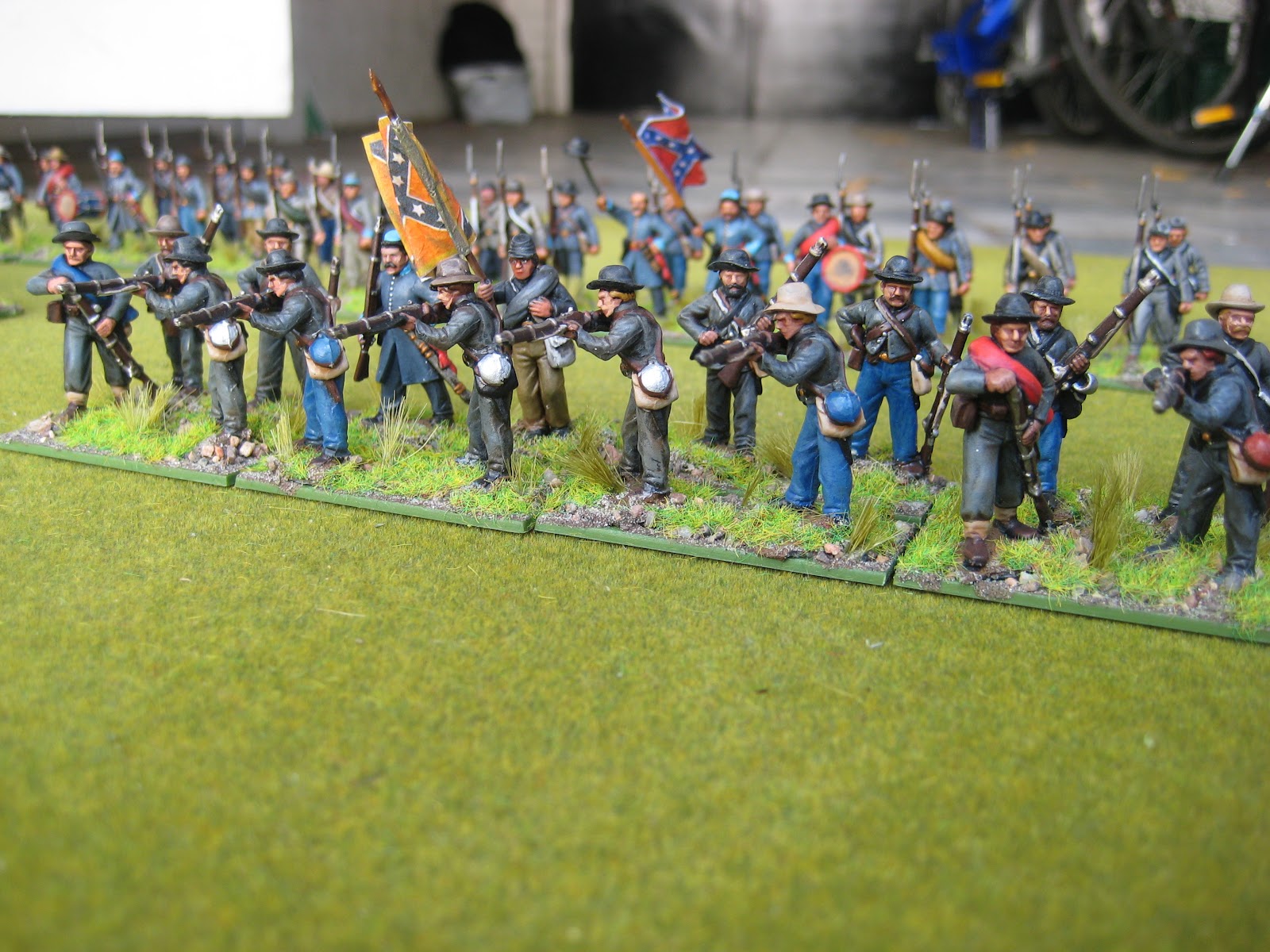

I am planning to use "They can't Hit an Elephant..." from Too Fat Lardies.
I have painted some brigadiers and will post pictures soon. Next on the list are some Perry artillery for both sides, then some confederate cavalry and lots more infantry.
The plan is to have about 40 stands (4 figs each) of infantry, two brigadiers, 1 divisional commander, 2 or 3 guns and a 6 stand cavalry regiment (of 2 figures each with separate dismounted stands) for both sides. Hopefully I can get this done by the end of 2009.

I have now managed to paint four boxes of the plastic infantry figures, half as federals and half as rebs. I like to have paired armies, then I can play games at home with no need for anybody to bring along figures.
Here are a few pictures of my first brigade of confederates:
I am planning to use "They can't Hit an Elephant..." from Too Fat Lardies.
I have painted some brigadiers and will post pictures soon. Next on the list are some Perry artillery for both sides, then some confederate cavalry and lots more infantry.
The plan is to have about 40 stands (4 figs each) of infantry, two brigadiers, 1 divisional commander, 2 or 3 guns and a 6 stand cavalry regiment (of 2 figures each with separate dismounted stands) for both sides. Hopefully I can get this done by the end of 2009.
Friday, 22 May 2009
Painting Valiant US Infantry
Last month's Wargames illustrated came with a sprue of Valiant GI's. I have already painted up a box of these lovely figures and some more were very welcome. The sprue has 16 figures. I assembled them and decided to try and paint them to a good wargame standard as quickly as possible. I took pictures as I went along.
First off I spray painted them with Humbrol Dark Brown (29). The aim here was to start from a shade that was in keeping with the uniform as a whole.

Next I painted the jacket and gaiters in GW Foundation Deneb Stone, followed by GW Foundation Talarn Flesh.


Next the helmet was painted with Revell Olive Green (35) and the trousers with Revell Olive Brown (86)

The metal parts of the M1 rifle were painted with GW Foundation Charandon Granite whilst the shoes, scabbard and wooden M1 parts were painted GW Foundation Calthan brown.

The whole figure was washed with GW Washes Devlan Mud

16 Figures took under 2 hours, I would say about 10 an hour. Standard - will not win any prizes but look good in a game. Finished results shown here.


Thanks for looking.
First off I spray painted them with Humbrol Dark Brown (29). The aim here was to start from a shade that was in keeping with the uniform as a whole.
Next I painted the jacket and gaiters in GW Foundation Deneb Stone, followed by GW Foundation Talarn Flesh.
Next the helmet was painted with Revell Olive Green (35) and the trousers with Revell Olive Brown (86)
The metal parts of the M1 rifle were painted with GW Foundation Charandon Granite whilst the shoes, scabbard and wooden M1 parts were painted GW Foundation Calthan brown.
The whole figure was washed with GW Washes Devlan Mud
16 Figures took under 2 hours, I would say about 10 an hour. Standard - will not win any prizes but look good in a game. Finished results shown here.
Thanks for looking.
Subscribe to:
Posts (Atom)
Greek Light Cavalry
Some Greek Light Cavalry; from the Victrix set of the same name. I did add in a few heads from the spares box.

-
 I constructed some 28mm Macedonian Prodromoi by adding cloaks and heads from the Victrix "Macedonian Greek and Successor Heavy Cavalry...
-
 It has taken me six months to get these Companions done. Victrix from their "Macedonian, Greek and Successor Heavy Cavalry" set. I...
-
I am now fully committed to a lengthy relationship with the 1809 Franco-Austrian war. Figures are being painted and books avidly read. One t...